Tuesday, November 23, 2010

Benedict XVI Doesn't Justify Condom Use

VATICAN CITY, NOV. 21, 2010 (Zenit.org).- A Vatican spokesman is clarifying that Benedict XVI is not justifying condom use, though the Pope said it could in some cases be a first step toward moral behavior. 

Jesuit Father Federico Lombardi, director of the Vatican press office, said this in a statement today regarding the words of Benedict XVI as recorded in a book, "Light of the World" (Ignatius Press), scheduled for release on Tuesday.

On Saturday, L'Osservatore Romano published some quotes from this book, which drew public interest and media misunderstandings.
At the end of the tenth chapter of the book, the writer, German journalist Peter Seewald, asked the Pontiff two questions on the fight against AIDS and the use of condoms.  Seewald referenced the Holy Father's comments on this topic while aboard the papal plane on the way to Cameroon and Angola in March, 2009.

Father Lombardi noted that Benedict XVI answered Seewald by insisting "on the fact that focusing only on condoms is equivalent to banalizing sexuality, which loses its meaning as an expression of love between persons and becomes a 'drug.'"
The spokesman affirmed that "fighting against banalization of sexuality is 'part of the great effort to help sexuality be valued positively and have a positive effect on man in his totality.'"
He added, "In the light of this broad and profound vision of human sexuality and the contemporary discussion of it, the Pope reaffirms that 'naturally the Church does not consider condoms as the authentic and moral solution' to the problem of AIDS."

"In this the Pope does not reform or change the Church's teaching, but reaffirms it," the priest stated.

"At the same time the Pope considers an exceptional circumstance in which the exercise of sexuality represents a real threat for the life of another," the spokesman explained.

Recovering awareness

The Ignatius Press blog, Ignatius Insight, published these excerpts of the book today, noting the Pontiff's words: "There may be a basis in the case of some individuals, as perhaps when a male prostitute uses a condom, where this can be a first step in the direction of a moralization, a first assumption of responsibility, on the way toward recovering an awareness that not everything is allowed and that one cannot do whatever one wants. But it is not really the way to deal with the evil of HIV infection. That can really lie only in a humanization of sexuality."

When Seewald asked the Holy Father to clarify the Church's position on the use of condoms, Benedict XVI responded: "She of course does not regard it as a real or moral solution, but, in this or that case, there can be nonetheless, in the intention of reducing the risk of infection, a first step in a movement toward a different way, a more human way, of living sexuality."

Father Lombardi explained, "In that case, the Pope does not morally justify the disordered exercise of sexuality but maintains that the use of a condom to reduce the danger of infection may be 'a first act of responsibility,'" as opposed to "not using it and exposing the other to risking his life."

"In this, the reasoning of the Pope certainly cannot be defined as a revolutionary change," he said.

"With courage Benedict XVI thus offers us an important contribution of clarification and reflection on a question that has long been debated," the priest affirmed.

He continued, "It is an original contribution, because on one hand it maintains fidelity to moral principles and demonstrates lucidity in refuting an illusory path like that of the 'confidence is condoms.'"
On the other hand, Father Lombardi said, "it manifests a comprehensive and far-seeing vision, attentive to uncovering the small steps -- even if only initial and still confused -- of an often spiritually and culturally impoverished humanity, toward a more human and responsible exercise of sexuality."

He pointed out that in this book, "the Pope again clearly stresses" that when he spoke to journalists aboard the papal plane "he had not intended to take a position on the problem of condoms in general."
Rather, the spokesman noted, the Pontiff "wanted to affirm with force that the problem of AIDS cannot be solved simply by distributing condoms, because much more needs to be done: prevention, education, help, counsel, being with people both to keep them from getting sick and in the case that they do get sick."

Thursday, November 11, 2010

OCTOBER 2010 UPDATES


Bring down the roof!


October, the Holy Rosary month was indeed a month of blessings for the seminary. The Consunji Group of Companies began the full-renovation of the Saint Michael’s dormitory. Some 25 workers are now working round the clock to complete the renovation by December 15. Most of the construction materials for the operation were shipped from Manila.  (Photos above show how the wooden beams of the dormitory roof are now being replaced with the sturdier metal trusses. The wooden window and door jams will also be replaced with concrete and metal frames. D.M. Consunji Group of Companies shoulders the full cost of the construction.) 


The seminary community also welcomed with great joy news that the Jesuits of the Japanese Province approved a P4.3 million grant for the SJVTS library. The amount represents 2/3 of the projected cost to renovate the library and add to its book collection. SJVTS invites more institutional donors to donate to the library so reconstruction of the facilities may already begin soon.


What's with WHITE?  Library fixtures now sport a brighter color ... WHITE!  May the lighter shade inspire seminarians to stay more and read more! 

Fr. Antonio Moreno, SJ - President of the Jesuit Higher Education Commission (JHEC) had recently approved the membership of SJVTS to the commission. JHEC counts as its members , colleges and universities administered by the Jesuits around the country. Through its membership in the commission, the seminary hopes to derive much needed learnings from the best academic practices of Jesuit schools.


St. Francis Assisi Courtyard:  SJVTS Building "C" a.k.a. St. Francis Assisi building also has a newly reconstructed courtyard.  Thanks to the generosity of friends and benefactors, the courtyard was completed just in time for the opening of the second semester.  

                                                                                                                     
Three alumni of the seminary were also ordained recently. Jose Anthony Garcia of Talibon, Bohol was ordained deacon last October 9. Deacons Cris Constantino and Arniel Villamero of Malaybalay were ordained priests last October 26 & 27, respectively. Deacon Ricky Bacolcol was likewise ordained priest in Jolo last November 9. Three other diaconal ordinations had also been scheduled this November.

Some 52 college seminarians from all over Mindanao were accommodated for two days in the seminary for their 2nd Phase (interviews) application to the seminary. The list of those to be finally accepted for school year 2011-2012 will be available sometime in February 2011.

San Lorenzo covered patio.  This year's San Lorenzo Ruiz fiesta was itself a source of blessing for the San Lorenzo sub-community.  Funds were raised to improve the building's covered patio (which included fencing and tiling).  Thanks again to our generous friends.


Incidentally, Frs. Junjun Borres, SJ (Rector of San Jose Seminary – Manila) and Eric Eusebio, SJ (Dean of the Loyola School of Theology) visited the seminary last October 5-6 for the Jesuit Formation sub-cluster meeting presided over by Father Rector Cel Reyes. During the semestral break, Fr. Manol Montesclaros, SJ gave retreats to the faculty of the different RVM schools and visited friends and family in Manila and Cebu. For his birthday celebration, Fr. Raul Dael hosted separate gatherings for friends and the SJVTS faculty. Fr. Julius Clavero went to Davao for the Theological Society of the Philippines conference on Global Warming. Fr. Demli Valmores who was supposed to accompany Father Julius was struck down with Dengue fever. Fr. Butch Zayas also went to Digos, Davao Oriental for the Mindanao Sulu Pastoral Conference last October 18-22. Bukidnon missionary Fr. Mat Sanchez was also around to give a conference on prayer to seminarians in Galilee Year who are preparing for their 30-day retreat at the Betania Retreat House in Malasag. 

The Silver Jubilee Edition of the “Tulay Ng Vianney,” the official SJVTS publication, was also released before the semestral break. The cover of the latest "Tulay" edition features the smiling face of newly ordained bishop and SJVTS Alumnus Bishop Joe Cabantan. The cost of printing the publication was shouldered by Legacy Printers.  Seminarian Eric Cantones (Malaybalay) is this year's Tulay editor-in-chief.


PLAGIARISM: Statement by the Catholic Educational Association of the Philippines

CEAP Issues Statement on Plagiarism
Thursday, 11 November 2010

In Defense of Honesty and Integrity

Do not pervert justice or show partiality. Do not accept a bribe, for a bribe blinds the eyes of the wise and twists the words of the righteous. Follow justice and justice alone, so that you may live and possess the land the LORD your God is giving you. Deuteronomy 16:19-20


As technology continues to make information highly available and accessible, the problem of plagiarism within the academic community and beyond has become even more menacing. Virtually, all academic institutions view it not only as a serious offense but also as a threat to intellectual creativity and advancement. The use of another person’s work without proper attribution is dealt with severely after due process, by imposing sanctions on erring members of the academe found guilty of intellectual dishonesty.

The long entrenched value of intellectual honesty in the academic sphere has been put to test with the advent of the Supreme Court decision entitled IN THE MATTER OF THE CHARGES OF PLAGIARISM, ETC., AGAINST ASSOCIATE JUSTICE MARIANO C. DEL CASTILLO.


The highest tribunal of the land, by positing that there was an absence of malicious intent, refused to acknowledge the act of lifting passages from various foreign publications without proper referencing as an act of PLAGIARISM. What is worse is that it used the same to support an entirely different theory from what the authors actually espouse.


The highest tribunal has set a higher threshold for plagiarism to be made punishable, and so may in fact abet plagiarism. What is the rationale for this? While it may seem reasonable to require “malicious intent” for an act of plagiarism, there can be no argument that plagiarism is still intellectual dishonesty and as such, one must be held accountable for such deplorable act. If a student quotes verbatim from another person's text “inadvertently,” or "carelessly,” or “without knowing this was another’s text”, is there no plagiarism here since there was no “malicious intent”? If a ghostwriter or a student in one’s study group has plagiarized texts for which another person is to take credit, is that person not co-responsible for his/her plagiarism?


How could our schools effectively teach the values of intellectual integrity and responsibility if in the light of the Supreme Court’s ruling, it could not take punitive action against such forms of plagiarism? In this sense, the Supreme Court’s decision abets a culture of intellectual sloth and dishonesty. For plagiarism is not only a legal issue but more importantly, a moral one. As institutions of learning, it is incumbent upon schools to develop in students the discipline of research and inculcate in them the values of excellence, responsibility, accountability, respect, honesty and integrity.


It is in this light that the Catholic Educational Association of the Philippines (CEAP), the largest association of Catholic schools, colleges and universities in the country with 1,290 members, lends its voice to this issue plaguing not only the legal community but Philippine academia as well. CEAP calls on all its member-schools to bring to light this threat to academic integrity and Christian formation by holding forums and other discussions on this issue ? highlighting its effect and impact on our mission as Catholic educators.


We call on the rest of Philippine academia and the entire citizenry to unite and speak with one voice and act collectively in defense of honesty and integrity.


We appeal to the Supreme Court to withdraw its threat of sanction against the 37 UP Law Professors who exercised their academic freedom in the service of honesty and integrity.


We support Justice Lourdes Aranal-Sereno’s call for the issuance of a corrected version of the ruling to reverse the “unimaginable problems” it has caused Philippine academia and restore the ability of the court to positively educate and influence the future of intellectual and academic discourse.


We invite every citizen to be vigilant in monitoring the development of this case so that our Supreme Court will truly uphold the rule of law, maintain integrity and trustworthiness so that our people in turn will restore the moral confidence that this democratic institution deserves.


In the midst of these trying times, we pray for enlightenment and moral strength. May the Holy Spirit guide us all to seek and discern the truth and be stewards of honesty and integrity.


(Original copy signed by all Officers and Members of the CEAP National Board of Directors, Chairpersons of the Advocacy Commission, Religious Commission and Superintendents Commission and the CEAP Executive Director. Copies published on Nov. 9, 2010 dailies; p.15 Philippine Daily Inquirer and p.17 Philippine Star)


9 November 2010

Wednesday, October 20, 2010

Letter to Seminarians from Pope Benedict XVI

From the Vatican, 18 October 2010, the Feast of Saint Luke the Evangelist.

Dear Seminarians,

When in December 1944 I was drafted for military service, the company commander asked each of us what we planned to do in the future. I answered that I wanted to become a Catholic priest. The lieutenant replied: “Then you ought to look for something else. In the new Germany priests are no longer needed”. I knew that this “new Germany” was already coming to an end, and that, after the enormous devastation which that madness had brought upon the country, priests would be needed more than ever. Today the situation is completely changed. In different ways, though, many people nowadays also think that the Catholic priesthood is not a “job” for the future, but one that belongs more to the past. You, dear friends, have decided to enter the seminary and to prepare for priestly ministry in the Catholic Church in spite of such opinions and objections. You have done a good thing. Because people will always have need of God, even in an age marked by technical mastery of the world and globalization: they will always need the God who has revealed himself in Jesus Christ, the God who gathers us together in the universal Church in order to learn with him and through him life’s true meaning and in order to uphold and apply the standards of true humanity. Where people no longer perceive God, life grows empty; nothing is ever enough. People then seek escape in euphoria and violence; these are the very things that increasingly threaten young people. God is alive. He has created every one of us and he knows us all. He is so great that he has time for the little things in our lives: “Every hair of your head is numbered”. God is alive, and he needs people to serve him and bring him to others. It does makes sense to become a priest: the world needs priests, pastors, today, tomorrow and always, until the end of time.


The seminary is a community journeying towards priestly ministry. I have said something very important here: one does not become a priest on one’s own. The “community of disciples” is essential, the fellowship of those who desire to serve the greater Church. In this letter I would like to point out – thinking back to my own time in the seminary – several elements which I consider important for these years of your journeying.

1. Anyone who wishes to become a priest must be first and foremost a “man of God”, to use the expression of Saint Paul (1 Tim 6:11). For us God is not some abstract hypothesis; he is not some stranger who left the scene after the “big bang”. God has revealed himself in Jesus Christ. In the face of Jesus Christ we see the face of God. In his words we hear God himself speaking to us. It follows that the most important thing in our path towards priesthood and during the whole of our priestly lives is our personal relationship with God in Jesus Christ. The priest is not the leader of a sort of association whose membership he tries to maintain and expand. He is God’s messenger to his people. He wants to lead them to God and in this way to foster authentic communion between all men and women. That is why it is so important, dear friends, that you learn to live in constant intimacy with God. When the Lord tells us to “pray constantly”, he is obviously not asking us to recite endless prayers, but urging us never to lose our inner closeness to God. Praying means growing in this intimacy. So it is important that our day should begin and end with prayer; that we listen to God as the Scriptures are read; that we share with him our desires and our hopes, our joys and our troubles, our failures and our thanks for all his blessings, and thus keep him ever before us as the point of reference for our lives. In this way we grow aware of our failings and learn to improve, but we also come to appreciate all the beauty and goodness which we daily take for granted and so we grow in gratitude. With gratitude comes joy for the fact that God is close to us and that we can serve him.


2. For us God is not simply Word. In the sacraments he gives himself to us in person, through physical realities. At the heart of our relationship with God and our way of life is the Eucharist. Celebrating it devoutly, and thus encountering Christ personally, should be the centre of all our days. In Saint Cyprian’s interpretation of the Gospel prayer, “Give us this day our daily bread”, he says among other things that “our” bread – the bread which we receive as Christians in the Church – is the Eucharistic Lord himself. In this petition of the Our Father, then, we pray that he may daily give us “our” bread; and that it may always nourish our lives; that the Risen Christ, who gives himself to us in the Eucharist, may truly shape the whole of our lives by the radiance of his divine love. The proper celebration of the Eucharist involves knowing, understanding and loving the Church’s liturgy in its concrete form. In the liturgy we pray with the faithful of every age – the past, the present and the future are joined in one great chorus of prayer. As I can state from personal experience, it is inspiring to learn how it all developed, what a great experience of faith is reflected in the structure of the Mass, and how it has been shaped by the prayer of many generations.


3. The sacrament of Penance is also important. It teaches me to see myself as God sees me, and it forces me to be honest with myself. It leads me to humility. The CurĂ© of Ars once said: “You think it makes no sense to be absolved today, because you know that tomorrow you will commit the same sins over again. Yet,” he continues, “God instantly forgets tomorrow’s sins in order to give you his grace today.” Even when we have to struggle continually with the same failings, it is important to resist the coarsening of our souls and the indifference which would simply accept that this is the way we are. It is important to keep pressing forward, without scrupulosity, in the grateful awareness that God forgives us ever anew – yet also without the indifference that might lead us to abandon altogether the struggle for holiness and self-improvement. Moreover, by letting myself be forgiven, I learn to forgive others. In recognizing my own weakness, I grow more tolerant and understanding of the failings of my neighbour.


4. I urge you to retain an appreciation for popular piety, which is different in every culture yet always remains very similar, for the human heart is ultimately one and the same. Certainly, popular piety tends towards the irrational, and can at times be somewhat superficial. Yet it would be quite wrong to dismiss it. Through that piety, the faith has entered human hearts and become part of the common patrimony of sentiments and customs, shaping the life and emotions of the community. Popular piety is thus one of the Church’s great treasures. The faith has taken on flesh and blood. Certainly popular piety always needs to be purified and refocused, yet it is worthy of our love and it truly makes us into the “People of God”.


5. Above all, your time in the seminary is also a time of study. The Christian faith has an essentially rational and intellectual dimension. Were it to lack that dimension, it would not be itself. Paul speaks of a “standard of teaching” to which we were entrusted in Baptism (Rom 6:17). All of you know the words of Saint Peter which the medieval theologians saw as the justification for a rational and scientific theology: “Always be ready to make your defence to anyone who demands from you an ‘accounting’ (logos) for the hope that is in you” (1 Pet 3:15). Learning how to make such a defence is one of the primary responsibilities of your years in the seminary. I can only plead with you: Be committed to your studies! Take advantage of your years of study! You will not regret it. Certainly, the subjects which you are studying can often seem far removed from the practice of the Christian life and the pastoral ministry. Yet it is completely mistaken to start questioning their practical value by asking: Will this be helpful to me in the future? Will it be practically or pastorally useful? The point is not simply to learn evidently useful things, but to understand and appreciate the internal structure of the faith as a whole, so that it can become a response to people’s questions, which on the surface change from one generation to another yet ultimately remain the same. For this reason it is important to move beyond the changing questions of the moment in order to grasp the real questions, and so to understand how the answers are real answers. It is important to have a thorough knowledge of sacred Scripture as a whole, in its unity as the Old and the New Testaments: the shaping of texts, their literary characteristics, the process by which they came to form the canon of sacred books, their dynamic inner unity, a unity which may not be immediately apparent but which in fact gives the individual texts their full meaning. It is important to be familiar with the Fathers and the great Councils in which the Church appropriated, through faith-filled reflection, the essential statements of Scripture. I could easily go on. What we call dogmatic theology is the understanding of the individual contents of the faith in their unity, indeed, in their ultimate simplicity: each single element is, in the end, only an unfolding of our faith in the one God who has revealed himself to us and continues to do so. I do not need to point out the importance of knowing the essential issues of moral theology and Catholic social teaching. The importance nowadays of ecumenical theology, and of a knowledge of the different Christian communities, is obvious; as is the need for a basic introduction to the great religions, to say nothing of philosophy: the understanding of that human process of questioning and searching to which faith seeks to respond. But you should also learn to understand and – dare I say it – to love canon law, appreciating how necessary it is and valuing its practical applications: a society without law would be a society without rights. Law is the condition of love. I will not go on with this list, but I simply say once more: love the study of theology and carry it out in the clear realization that theology is anchored in the living community of the Church, which, with her authority, is not the antithesis of theological science but its presupposition. Cut off from the believing Church, theology would cease to be itself and instead it would become a medley of different disciplines lacking inner unity.


6. Your years in the seminary should also be a time of growth towards human maturity. It is important for the priest, who is called to accompany others through the journey of life up to the threshold of death, to have the right balance of heart and mind, reason and feeling, body and soul, and to be humanly integrated. To the theological virtues the Christian tradition has always joined the cardinal virtues derived from human experience and philosophy, and, more generally, from the sound ethical tradition of humanity. Paul makes this point this very clearly to the Philippians: “Finally, brothers, whatever is true, whatever is honourable, whatever is just, whatever is pure, whatever is pleasing, whatever is commendable, if there is any excellence and if there is anything worthy of praise, think about these things” (4:8). This also involves the integration of sexuality into the whole personality. Sexuality is a gift of the Creator yet it is also a task which relates to a person’s growth towards human maturity. When it is not integrated within the person, sexuality becomes banal and destructive. Today we can see many examples of this in our society. Recently we have seen with great dismay that some priests disfigured their ministry by sexually abusing children and young people. Instead of guiding people to greater human maturity and setting them an example, their abusive behaviour caused great damage for which we feel profound shame and regret. As a result of all this, many people, perhaps even some of you, might ask whether it is good to become a priest; whether the choice of celibacy makes any sense as a truly human way of life. Yet even the most reprehensible abuse cannot discredit the priestly mission, which remains great and pure. Thank God, all of us know exemplary priests, men shaped by their faith, who bear witness that one can attain to an authentic, pure and mature humanity in this state and specifically in the life of celibacy. Admittedly, what has happened should make us all the more watchful and attentive, precisely in order to examine ourselves earnestly, before God, as we make our way towards priesthood, so as to understand whether this is his will for me. It is the responsibility of your confessor and your superiors to accompany you and help you along this path of discernment. It is an essential part of your journey to practise the fundamental human virtues, with your gaze fixed on the God who has revealed himself in Christ, and to let yourselves be purified by him ever anew.


7. The origins of a priestly vocation are nowadays more varied and disparate than in the past. Today the decision to become a priest often takes shape after one has already entered upon a secular profession. Often it grows within the Communities, particularly within the Movements, which favour a communal encounter with Christ and his Church, spiritual experiences and joy in the service of the faith. It also matures in very personal encounters with the nobility and the wretchedness of human existence. As a result, candidates for the priesthood often live on very different spiritual continents. It can be difficult to recognize the common elements of one’s future mandate and its spiritual path. For this very reason, the seminary is important as a community which advances above and beyond differences of spirituality. The Movements are a magnificent thing. You know how much I esteem them and love them as a gift of the Holy Spirit to the Church. Yet they must be evaluated by their openness to what is truly Catholic, to the life of the whole Church of Christ, which for all her variety still remains one. The seminary is a time when you learn with one another and from one another. In community life, which can at times be difficult, you should learn generosity and tolerance, not only bearing with, but also enriching one another, so that each of you will be able to contribute his own gifts to the whole, even as all serve the same Church, the same Lord. This school of tolerance, indeed, of mutual acceptance and mutual understanding in the unity of Christ’s Body, is an important part of your years in the seminary.


Dear seminarians, with these few lines I have wanted to let you know how often I think of you, especially in these difficult times, and how close I am to you in prayer. Please pray for me, that I may exercise my ministry well, as long as the Lord may wish. I entrust your journey of preparation for priesthood to the maternal protection of Mary Most Holy, whose home was a school of goodness and of grace. May Almighty God bless you all, the Father, the Son and the Holy Spirit.

Yours devotedly in the Lord, Benedictus PP. XVI


Saturday, October 16, 2010

Pope Benedict names new Cebu archbishop

By UCANEWS
Published Date: October 15, 2010

Pope Benedict XVI named Archbishop Jose Palma of Palo as the new head of the Archdiocese of Cebu. Archbishop Palma, vice president of the Catholic Bishops’ Conference of the Philippines (CBCP), replaced Cardinal Ricardo Vidal who retired.


Archbishop Edward Joseph Adams, papal nuncio to the Philippines, relayed the news of Archbishop Palma’s appointment to Monsignor Pedro Quitorio, media director of the bishop conference.  “I wrote to inform you that the Holy Father Pope Benedict XVI has appointed His Excellency Most Rev. Jose S. Palma until now the Archbishop of Palo, as Archbishop of Cebu,” read the letter of Archbishop Adams dated Oct. 14.


Cardinal Vidal submitted his retirement papers to the Pope in February 2006 when he turned 75 years old. Canon law requires that Catholic bishops tender their resignation on their 75th birthday.  Cardinal Vidal will continue to head Cebu archdiocese as Apostolic Administrator with powers of an ordinary bishop until Archbishop Palma’s installation.

 
SHORT BIOGRAPHY:   Archbishop Jose S. Palma, DD, SThD was born on March 19, 1950 in Dingle, Iloilo. He was ordained a priest on Aug. 21, 1976. He was appointed Titular Bishop of Vazaritanae Diddensis and Auxiliary Bishop of Cebu on Nov. 28, 1997. His episcopal ordination was on Jan. 13, 1998. On January 13, 1999, he was appointed Bishop of Calbayog. His installation took place on March 9, 1999. He was appointed Archbishop of Palo on March 19, 2006 and was installed there on May 2, 2006. He was appointed Diocesan Administrator of Calbayog on March 19, 2006. At the same time (that is, from March 19, 2006) he was the Diocesan Administrator of Calbayog until Jan. 5, 2007 (when the Diocese of Calbayog was given her own bishop). On July 11, 2009, he was elected Vice President of the Catholic Bishops Conference of the Philippines (CBCP).

Tuesday, October 12, 2010

SEPTEMBER 2010 UPDATES

Seminarians in Galilee Year went through their Psycho-Spiritual Integration seminar last September with Ms. Eva Galvey and Sr. Maria Fe Magbanua of the Emmaus Center.   GY Director Fr. Raul Dael together with Fr. Rogel Abais, SJ and Frank Savadera, SJ assisted in the catharsis part of the program. Fr. Rogel also bade the seminary goodbye last month after concluding his course in Scriptures. His ‘despedida’ party was made extra special with the birthday celebration of SJVTS counselor Ms. Venus Guibone. Visiting professor Fr. Jorge Benieto Mora (Peru) also celebrated his 50th year as a Jesuit. 
Lining up for seats at Xavier U.

... the BIGGER ... err ... LONGER line!
  The seminarians also trooped to the Xavier University Little Theater to watch a play (an adaptation of 'Oedipus Rex' in Pilipino) staged by the Mindanao State University. The 4th Year seminarians also had their special sessions in Pastoral Counseling with Fr. Ted Gonzales, SJ. Incidentally, our graduating batch all successfully passed their Ad Audiendas exams last month. They are now equipped enough to hear confessions (of course, after their ordination). Father Rector Cel Reyes himself and Fr. Demli Valmores teamed up for the Ad Auds reviews. 


Making sure that the games are fair and square!
  

Ursuline sisters posing with the young San Lorenzo


For the second straight year, the San Lorenzo sub-community topped last month’s Sports Intramurals. The Cheerdance championship went to the St. Francis Xavier sub-community. 
             Also in September, the formators went back to Manolo Fortich, Bukidnon for a brief recollection. Fr. Jun Kentilitisca and the Calva family hosted the group. 

             Fr. Manol Montesclaros also went to Davao City last month for a Bukas Loob sa Diyos regional meeting.


Sunday, September 12, 2010

AUGUST 2010 ACTIVITIES

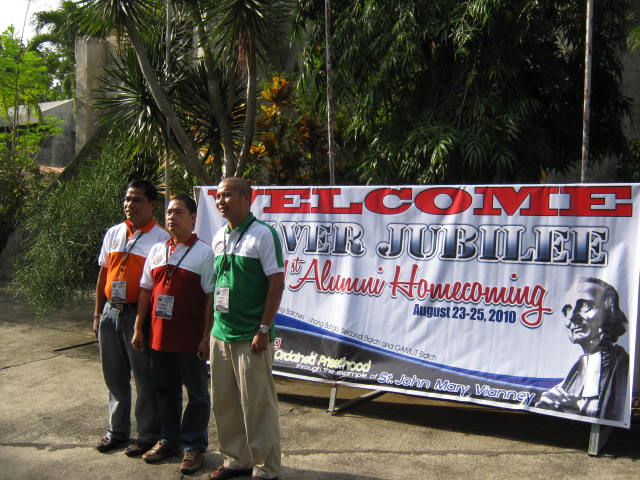
             The SJVTS 21st Alumni Homecoming was successfully held last August. Fr. Celerino Reyes, SJ was also formally installed as the seminary’s 6th Rector. The “St. John Mary Vianney Awards” were also handed to the family and communities of SJVTS Founding Fathers Giuseppe Raviolo, SJ and Bishop Patrick Cronin and seminary friend/ benefactor Madame Laureana Rosales. The posthumous awards were received by the Provincial Superior of the Columban missionaries Fr. Patrick O’Donoughue, Jesuit Provincial Fr. Jose Magadia, SJ and Mrs. Fe Juarez for the family of Madame Rosales.
Posing for posterity before the huge 'Welcome' banner!
             The new Alumni Directory was also distributed among the almost 200 alumni priests and lay partners who attended the homecoming. A play about the life and influence of St. John Mary Vianney, which was directed by Palanca Awardee Ms. Ameta Taguchi, was also staged. Seminarians and even some of the seminary staff took part in the play as actors. Archbishop of Manila Gaudencio Cardinal Rosales also returned to the seminary a second time in three weeks to deliver a talk among members of the alumni.  Preparations for this year's Alumni Homecoming were spearheaded by Fr. Nathan Lerio. 
           Also in August, seminary fathers trooped to the various testing areas of Mindanao to conduct the First Phase – Admission Examinations to prospective new theologians. Some 80 college seminarians took the qualifying examinations in Butuan, Davao, Cagayan de Oro and Bohol.
            The entire SJVTS community also joined the High Mass celebrated by Bishop Antonio Ledesma, SJ at the CDO Cathedral in celebration of the City Fiesta.