By UCANEWS
Published Date: October 15, 2010
Pope Benedict XVI named Archbishop Jose Palma of Palo as the new head of the Archdiocese of Cebu. Archbishop Palma, vice president of the Catholic Bishops’ Conference of the Philippines (CBCP), replaced Cardinal Ricardo Vidal who retired.
Archbishop Edward Joseph Adams, papal nuncio to the Philippines, relayed the news of Archbishop Palma’s appointment to Monsignor Pedro Quitorio, media director of the bishop conference. “I wrote to inform you that the Holy Father Pope Benedict XVI has appointed His Excellency Most Rev. Jose S. Palma until now the Archbishop of Palo, as Archbishop of Cebu,” read the letter of Archbishop Adams dated Oct. 14.
Cardinal Vidal submitted his retirement papers to the Pope in February 2006 when he turned 75 years old. Canon law requires that Catholic bishops tender their resignation on their 75th birthday. Cardinal Vidal will continue to head Cebu archdiocese as Apostolic Administrator with powers of an ordinary bishop until Archbishop Palma’s installation.
SHORT BIOGRAPHY: Archbishop Jose S. Palma, DD, SThD was born on March 19, 1950 in Dingle, Iloilo. He was ordained a priest on Aug. 21, 1976. He was appointed Titular Bishop of Vazaritanae Diddensis and Auxiliary Bishop of Cebu on Nov. 28, 1997. His episcopal ordination was on Jan. 13, 1998. On January 13, 1999, he was appointed Bishop of Calbayog. His installation took place on March 9, 1999. He was appointed Archbishop of Palo on March 19, 2006 and was installed there on May 2, 2006. He was appointed Diocesan Administrator of Calbayog on March 19, 2006. At the same time (that is, from March 19, 2006) he was the Diocesan Administrator of Calbayog until Jan. 5, 2007 (when the Diocese of Calbayog was given her own bishop). On July 11, 2009, he was elected Vice President of the Catholic Bishops Conference of the Philippines (CBCP).
Chronicles of Life by a Jesuit assigned in Cagayan de Oro City, Northern Mindanao, Philippines
Saturday, October 16, 2010
Tuesday, October 12, 2010
SEPTEMBER 2010 UPDATES
Seminarians in Galilee Year went through their Psycho-Spiritual Integration seminar last September with Ms. Eva Galvey and Sr. Maria Fe Magbanua of the Emmaus Center. GY Director Fr. Raul Dael together with Fr. Rogel Abais, SJ and Frank Savadera, SJ assisted in the catharsis part of the program. Fr. Rogel also bade the seminary goodbye last month after concluding his course in Scriptures. His ‘despedida’ party was made extra special with the birthday celebration of SJVTS counselor Ms. Venus Guibone. Visiting professor Fr. Jorge Benieto Mora (Peru) also celebrated his 50th year as a Jesuit.
The seminarians also trooped to the Xavier University Little Theater to watch a play (an adaptation of 'Oedipus Rex' in Pilipino) staged by the Mindanao State University. The 4th Year seminarians also had their special sessions in Pastoral Counseling with Fr. Ted Gonzales, SJ. Incidentally, our graduating batch all successfully passed their Ad Audiendas exams last month. They are now equipped enough to hear confessions (of course, after their ordination). Father Rector Cel Reyes himself and Fr. Demli Valmores teamed up for the Ad Auds reviews.
| Lining up for seats at Xavier U. |
| ... the BIGGER ... err ... LONGER line! |
| Making sure that the games are fair and square! |
| Ursuline sisters posing with the young San Lorenzo |
For the second straight year, the San Lorenzo sub-community topped last month’s Sports Intramurals. The Cheerdance championship went to the St. Francis Xavier sub-community.
Also in September, the formators went back to Manolo Fortich, Bukidnon for a brief recollection. Fr. Jun Kentilitisca and the Calva family hosted the group.
Fr. Manol Montesclaros also went to Davao City last month for a Bukas Loob sa Diyos regional meeting.
Sunday, September 12, 2010
AUGUST 2010 ACTIVITIES
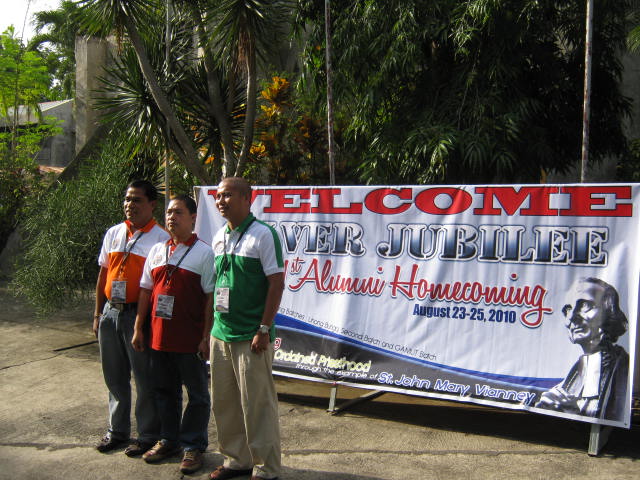
The SJVTS 21st Alumni Homecoming was successfully held last August. Fr. Celerino Reyes, SJ was also formally installed as the seminary’s 6th Rector. The “St. John Mary Vianney Awards” were also handed to the family and communities of SJVTS Founding Fathers Giuseppe Raviolo, SJ and Bishop Patrick Cronin and seminary friend/ benefactor Madame Laureana Rosales. The posthumous awards were received by the Provincial Superior of the Columban missionaries Fr. Patrick O’Donoughue, Jesuit Provincial Fr. Jose Magadia, SJ and Mrs. Fe Juarez for the family of Madame Rosales.
The new Alumni Directory was also distributed among the almost 200 alumni priests and lay partners who attended the homecoming. A play about the life and influence of St. John Mary Vianney, which was directed by Palanca Awardee Ms. Ameta Taguchi, was also staged. Seminarians and even some of the seminary staff took part in the play as actors. Archbishop of Manila Gaudencio Cardinal Rosales also returned to the seminary a second time in three weeks to deliver a talk among members of the alumni. Preparations for this year's Alumni Homecoming were spearheaded by Fr. Nathan Lerio.
Also in August, seminary fathers trooped to the various testing areas of Mindanao to conduct the First Phase – Admission Examinations to prospective new theologians. Some 80 college seminarians took the qualifying examinations in Butuan, Davao, Cagayan de Oro and Bohol.
The entire SJVTS community also joined the High Mass celebrated by Bishop Antonio Ledesma, SJ at the CDO Cathedral in celebration of the City Fiesta.
| Posing for posterity before the huge 'Welcome' banner! |
Also in August, seminary fathers trooped to the various testing areas of Mindanao to conduct the First Phase – Admission Examinations to prospective new theologians. Some 80 college seminarians took the qualifying examinations in Butuan, Davao, Cagayan de Oro and Bohol.
The entire SJVTS community also joined the High Mass celebrated by Bishop Antonio Ledesma, SJ at the CDO Cathedral in celebration of the City Fiesta.
Saturday, September 11, 2010
NEW LITURGY: Small word, big problem
From the Union of Catholic Asian News (September 10, 2010) By William Grimm
People who have studied English as a second language tell me that three of the biggest challenges they encounter are pronouns, prepositions and articles.
Articles (a, an, the) are the most difficult. Which one to use or even whether to use one or not causes them anguish. The use or non-use of such a short word can make a huge difference in the meaning of a phrase or sentence.
One example of the problem can be found in the translation of the Mass that Rome has recently declared must be used for celebrations in English.
That is relevant to the Church in Asia because in large parts of the continent, English is often used in worship. In South Asia and other parts of the former British Empire as well as in the Philippines, English remains a living language.
In just about every country of Asia, overseas workers from the Philippines worship in English. English is also the language of the Federation of Asian Bishops’ Conferences, the FABC.
The new translation has been criticized on many points. In an attempt to follow as closely as possible a Latin original, the English is stilted, verbose and at times nonsensical because of poor grammar.
The whole process of its development has been marked by secrecy and by spinelessness on the part of most of the world’s English-speaking bishops who acquiesced in the destruction by non-English speakers of generally acclaimed new translations prepared a decade or more ago.
Tens of thousands of Catholics have signed a petition asking that the new translation not be imposed until after a period of trial to see if it “works.” Of course, the petition has been ignored by the bishops and curia.
An ancient principle of theology is “lex orandi, lex credendi.” The way we pray is the way we believe. If our prayer is not in accord with the faith of the Church, it will lead people away from that faith.
The worst problem of the new translation is that it will, in fact, bring heresy into the Mass, and all because of an article.
Currently, the words over the cup during the Eucharistic Prayer speak of the Lord’s blood being spilled “for you and for all.” That translates the idea of the probable Aramaic words of Jesus and the Catholic faith that God’s will is that all be saved. The Latin text reads, “pro multis,” which also implies all-inclusiveness. Good Latin but heretical English will have priests proclaiming that Christ shed his blood ‘for you and for many’
Ever since the currently-used English translation appeared, some people have objected to its inclusiveness. I have run across those who object precisely because they neither believe nor want God to desire the salvation of all.
When the new translation was being prepared, it was decided by someone that the word “multis” must be rendered literally as either “many” or “the many.” There are two possibilities because Latin does not have articles.
The secrecy of the whole process precludes knowing who made decisions or what their qualifications to do so are, but apparently because Latin does not use articles, the English translation will not do so, either. Good Latin but heretical English will have priests proclaiming that Christ shed his blood “for you and for many.”
The problem arises from omitting that three-letter word, “the.” In English, “many” without the article is an indeterminate word. It can mean a handful, a few dozen, a few thousand. It never means, however, the majority, let alone everyone. On the other hand, “the many” can mean everyone. In order to be slavishly faithful to Latin grammar, Rome is telling us that we must pray heresy, saying in effect that Jesus shed his blood for quite a few, but certainly not all.
That presents priests with a dilemma. We can obey men who obviously do not know what they want us to talk about or we can continue to proclaim the actual faith of the Church. I have talked with priests about this and find that many (the many?) say that fidelity to the faith of the Church and their mission to proclaim God’s love will force them to disobedience to the liturgical rule of that same Church.
None are happy about that, not least because it might result in their suffering at the hands of their bishops. There is, however, reason for these priests to take heart. Though he certainly did not intend it, Pope Benedict has shown the way to go.
In his apostolic letter Summorum Pontificum broadening the use of the 1962 Latin Mass he says, “in some regions, no small numbers of faithful adhered and continue to adhere with great love and affection to the earlier liturgical forms” and goes on to say that such dedication (and some 40 years of defiance that accompanied it) deserve to be rewarded.
The clergy and laity of Germany have refused to accept a newly-translated funeral rite and the bishops there reported to Rome that “the new ritual must be considered a failure.”
The result is that the new translation of the funeral rite has been abandoned. This is probably just the beginning of a movement in the Church, a movement that may be of the Holy Spirit. It appears to me that when the new English Mass translation becomes mandatory, many priests, if not the many, will continue to proclaim the good news that Christ died for all.
Father William Grimm is a Tokyo-based priest and publisher of UCA News and former editor-in-chief of “Katorikku Shimbun,” Japan’s Catholic weekly
Wednesday, August 25, 2010
San Lorenzo Ruiz Sub-Community Courtyard
Here are some photos of our newly improved San Lorenzo Ruiz sub-community courtyard. We thank all our friends and benefactors for all the help. We also thank architects Linda Escaba and Giovanni Hojilla for the simple yet elegant design of the new courtyard.
Tuesday, August 24, 2010
Alumni Homecoming:FIRST NIGHT
| Father Cel Reyes receives his Rector's Cross-Medallion from Bishop Antonio Ledesma, SJ DD |
| St. John Vianney ... pray for us! |
| Imitating his IDOL! |
| Fr. Patrick O'Donoghue, MSSC knew the late Bishop Cronin since he was 11 years old. |
| Father Magadia remembers Father Raviolo being called "Father Tambiolo" |
| Oooops ... who fits the hairshirt? |
| Manning the Audio! |
| Encore! Encore! Best Director with Best Host! |
| Palanca Awardee and BEST CR Awardee! |
Subscribe to:
Posts (Atom)